


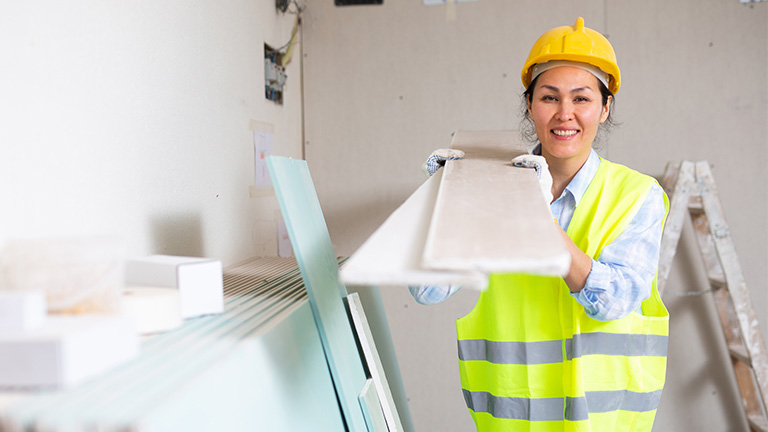
The project “Applied Model for Strengthening the Inclusion of Women in Construction Sector Companies” is an initiative being developed by the Faculty of Government of the University of Chile, promoted by the Chilean Chamber of Construction (CChC) through its Women’s Commission and OTIC CChC, within the framework of the Talent Development in the Construction Industry in Chile pillar.
The project officially began on August 4, 2025, and is funded through 5% of the SENCE Tax Incentive Program. Its objective is to develop and validate a model that promotes the incorporation and professional development of women in the construction sector by providing tools, strategies, and guidelines to advance toward greater female participation in a sustainable way.
The project is currently in the stage of developing the model manual, which aims to systematize practices and guidelines that can be used by companies in the sector to strengthen the recruitment, integration, and retention of women in the construction industry.
Paulina Temer Cadiu, National President of the Women’s Commission of the Chilean Chamber of Construction
Contact: paulinatemer@cipres.cl
Claudia Vargas Pallavicini, Project Director, Faculty of Government, University of Chile
Contact: cpv.vargas@gmail.com
Loreto Martínez Oyarce, Project Manager of the project “Applied Model for Strengthening the Inclusion of Women in Construction Sector Companies”, Faculty of Government, University of Chile
Contact: loretomartinez@uchile.cl
Perhaps it started when I said I wanted to pursue a career in the STEM field and my abilities were questioned simply because I was a woman. It was not an outright rejection; there was affection and support, but also that seemingly harmless comment: “it’s a man’s world.” That was when something started to bother me: the feeling that, even without saying it explicitly, it seemed that not all careers were for women, that the future came with implicit limits.
Over time I realized that it was not just a phrase. Those same mindsets later become wage gaps, slower professional trajectories, and doors that open differently depending on gender. That is when I became certain: it was not enough to adapt; we had to push for real change. And the CChC is a key space to do so, because this sector needs talent without labels or extra explanations. No woman should have to justify her vocation in order to contribute to the country’s development.
(Paulina Temer Cadiu)
The most visible barriers are cultural: stereotypes, inherited beliefs, and the false idea that certain roles are not for women. Added to this are structural obstacles: lack of adequate infrastructure, non-inclusive recruitment processes, and a persistent gap in work–life balance, along with limited shared responsibility in caregiving.
When these barriers overlap, the effect is clear: more fragile career paths, higher dropout rates, and the constant feeling of having to prove more in order to reach the same place. As a result, talent is lost before it can fully develop.
And that, beyond being an equity issue, is a strategic problem for an industry that needs to grow, innovate, and project itself into the future.
(Paulina Temer Cadiu)
The project we lead from the Faculty of Government of the University of Chile aims to design, validate, and pilot an applied model to strengthen the inclusion and retention of women in the construction industry, a sector that in Chile has one of the lowest rates of female participation, with only 8.4% of the total workforce.
The initiative is being developed at the request of the Chilean Chamber of Construction (CChC) and OTIC CChC, acting as commissioning entities for the study. It responds to the persistent gender gaps facing the sector. The project gathers and systematizes quantitative and qualitative evidence on barriers, inequalities, and opportunities, as well as best practices implemented by companies in the sector both nationally and internationally.
Based on this diagnosis, the project will propose a model with concrete tools for implementing inclusive and sustainable practices within companies, along with governance structures and monitoring indicators to track progress and promote continuous improvement.
In this way, the project aims to contribute to gender equality, increased female labor participation, and the strengthening of sustainability and competitiveness within the construction sector.
Finally, it should be noted that the project is financed through 5% of the tax incentive managed by the National Training and Employment Service (SENCE).
(Loreto Martínez Oyarce)
The initiative, titled “Applied Model for Strengthening the Inclusion of Women in Construction Sector Companies,” which officially began on August 4, 2025, has successfully completed its first stage of systematization.
The main achievement so far is the preparation of a systematization report on the current situation of female participation in the construction sector and national and international best practices. Developed between September and October, the report analyzes and systematizes the current situation of women in the industry, identifying their level of representation and the gaps and challenges associated with their incorporation, retention, and professional development.
To achieve this, the study conducted a comprehensive analysis of women’s representation, identified gaps, barriers, and challenges based on various existing studies, and examined regulatory aspects that either support or hinder their participation.
The methodology included rigorous documentary review, statistical analysis of national and international databases, and 24 semi-structured interviews with 51 key stakeholders, including representatives from the public sector, private sector, academia, and civil society.
Another key advancement has been the collection of successful experiences and practices related to the inclusion and development of women in construction, both nationally (e.g., ECOMAC, SALFACORP) and internationally (e.g., Builders Code, Women Can Build LatAm).
This body of information provides a comprehensive perspective that goes beyond diagnosis, offering effective solutions through concrete examples of companies that have successfully integrated women into their structures and teams.
These results not only provide an integrated map of the critical factors explaining low female participation but also lay the groundwork for the project’s next phase, which will focus on designing, validating, and documenting an innovative model, along with defining a system of indicators (KPIs) to measure its progress.
(Loreto Martínez Oyarce and Claudia Vargas Pallavicini)
The main challenge is navigating organizational cultures that are still in the process of change. Social transformations take time, and our industry is learning to recognize and value diverse talents.
There are still gaps in growth opportunities, biases in the allocation of responsibilities, and often the feeling that women must prove themselves “twice as much” in order to be taken seriously.
But it is also true that something has already begun to change. More and more women are entering, staying, and leading transformations from within. The industry is learning, evolving, and opening up. That process is not immediate, but it has already begun—and there is no turning back.
(Paulina Temer Cadiu)
During the analytical process and the interviews conducted with 51 key stakeholders, deeply impactful findings emerged that reflect the human reality faced by women in the sector.
One recurring experience we were able to systematize was the constant questioning of women’s leadership capacity and the need for continuous proof of competence, especially during their early years on construction sites. Many women feel they must constantly overperform to gain validation and are often forced to adopt behaviors perceived as masculine, or to blend in as a survival tactic to avoid harassment or being undermined.
Another significant aspect documented by the project was the direct impact of the sexual division of labor and the stigma surrounding motherhood as persistent barriers to retention and professional development. Women face greater difficulties in balancing work, personal life, and family responsibilities, as caregiving duties culturally fall more heavily on them. This overload limits their availability for long work hours or promotions.
The report highlights that pregnancy and child-rearing are still perceived as a “problem” in the demanding environment of construction sites, leading to biases that discourage hiring or promoting women of childbearing age.
This diagnosis, reinforced by cases in companies where caregiving issues were the main reason women left the sector, underscores that without genuine work–life balance and shared responsibility policies, sustainable inclusion remains a structural challenge.
(Loreto Martínez Oyarce and Claudia Vargas Pallavicini)
Enter without asking for permission and with the conviction that your talent is essential for the country. For Chile to grow, we need to bring more women into construction: their ideas, perspectives, and skills make a more diverse and stronger productive matrix possible.
This sector is changing, and progress requires that we work together with the State, companies, organizations, and civil society. There is space, there is a future, and there are real opportunities. Take them.
Chile needs you inside, not watching from the outside. The construction industry belongs to you as well.
(Paulina Temer Cadiu)
If you want, I can also polish it into a more journalistic English version (like for an international website or magazine), which would make it shorter, smoother, and more natural for English readers.
More information here.
El próximo 25 de septiembre de 2025, celebramos el evento ‘Women Can Build: Una iniciativa catalizadora de la igualdad de género en el sector de la construcción de Latinoamérica y Europa‘, que se organiza en la la Oficina del Parlamento Europeo en Madrid y se retransmitirá en directo:
🕒 Horarios:
👉 Si estas fuera de Madrid (España) y no te lo quieres perder ¡Inscríbete, te esperamos!
El próximo 25 de septiembre de 2025, la Oficina del Parlamento Europeo en Madrid (Paseo de la Castellana, 46) acogerá el evento ‘Women Can Build: Una iniciativa catalizadora de la igualdad de género en el sector de la construcción de Latinoamérica y Europa‘.
👉 Inscríbete (plazas limitadas) ¡Te esperamos!
El próximo 25 de septiembre de 2025, la Oficina del Parlamento Europeo en Madrid (Paseo de la Castellana, 46) acogerá el evento ‘Women Can Build: Una iniciativa catalizadora de la igualdad de género en el sector de la construcción de Latinoamérica y Europa‘.
👉 Inscríbete (plazas limitadas) ¡Te esperamos!
Join the community of experts and professionals in the sector who promote gender equality in construction. Fill out the following form and briefly share your story, project, or idea, and we will get in touch with you.
We look forward to hearing from you!