


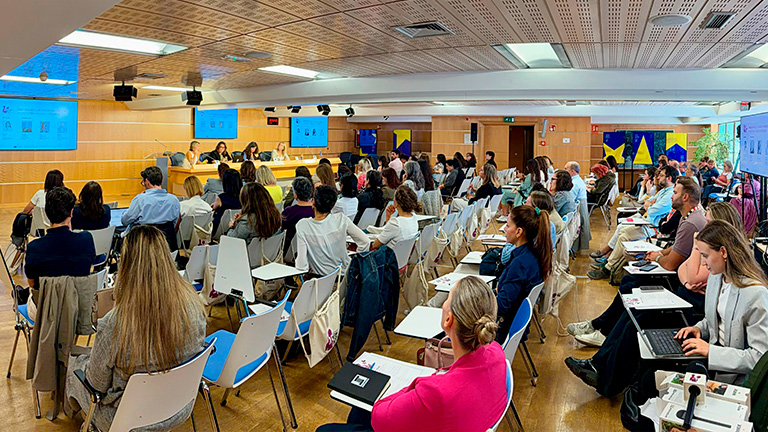
The European Parliament Office in Madrid hosted the final event of ‘Women Can Build: A catalytic initiative for gender equality in the construction sector in Latin America and Europe’, organised by the Fundación Laboral de la Construcción this Thursday; a session that brought together 385 people (85 in-person attendees and 300 connected online) and united professionals and public and private entities from both continents to create a space for dialogue on attracting, integrating and empowering women in one of the traditionally most male-dominated sectors.
The meeting, broadcast live via streaming to facilitate international participation, aimed to present the progress of the ‘Women Can Build LatAm’ project (co-funded by the European Union’s Erasmus+ programme) and share good practices to boost the participation of more women in male-dominated sectors.
High-level speaker programme
The session began at 14:30 (Spanish time) with a coffee corner to facilitate networking amongst attendees, with the opening and hosting by Beatriz Oliete, Head of International Projects at the Fundación Laboral de la Construcción, who spearheaded the ‘Women Can Build’ initiative in 2017.
In her welcome address, Beatriz Oliete emphasised that “all women can find their vocation in the construction sector”, and reminded attendees that projects like Women Can Build contribute to making this happen, as “more than a project, it is a community, an international movement that connects continents and demonstrates that tomorrow’s construction will be stronger, more innovative and more humane if it is built with equality”.
Among the featured speakers, María Paz Achurra, director and founder of RedMaestra (Chile), recipient of the Women Builders Award, included in 100 Women Leaders 2023 and 50 Genias Award 2024 in the Equity and Empowerment Category, shared her experience on female empowerment in construction. For María Paz Achurra, “the sector offers enormous development opportunities, but there was an almost invisible talent: women. Through trades, they can make their way and transform the labour market”. In the RedMaestra project, she explained, “we train and support women in their technical training in trades, transforming them into reference masters. Now we want to enhance women’s capabilities and talents for an inclusive future, where trades have no gender”, advocating for “working to make visible, open spaces to attract more women and join this community: women also build the future”.
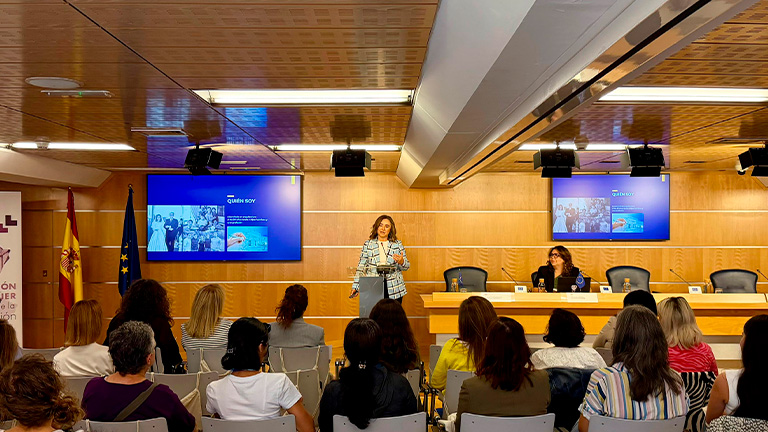
For her part, Matilde Daganzo, coordinator of the ‘Women Can Build LatAm’ project and International Projects technician at the Fundación Laboral de la Construcción, presented a comparative analysis on women’s presence in construction between Latin America and Europe, highlighting advances, challenges and differences between both regional contexts. In Matilde Daganzo’s words, “we deconstruct stereotypes to build a new sector, where women’s presence in Spain represents 11.2% of the female workforce in construction, compared to 8.2% in Chile and 4.3% in Argentina”, describing vocational guidance and gender-perspective training as “important”.
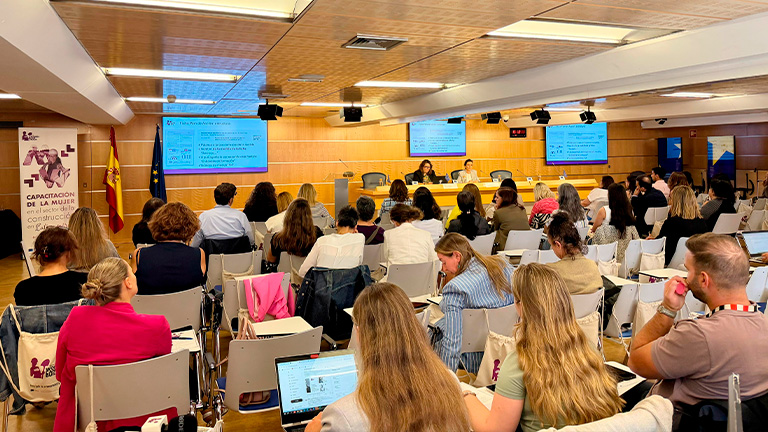
Debate panel: pioneering initiatives in male-dominated sectors
One of the key moments of the event was the debate panel on initiatives that attract women to traditionally male-dominated sectors, where significant projects committed to equality were highlighted.
This includes ‘Cimientos de Igualdad’ (Foundations of Equality), presented by Ángela Baldellou, managing director of the Official College of Architects of Madrid, COAM, and promoter of this CSCAE initiative. In her speech, she highlighted the challenge of transformation, industrialisation and digitalisation of the sector, “and this paradigm means that professions have the opportunity to be done differently, not just with the stigma of ‘construction work’. We had to be able to attract women to construction sites, and highlight an added value that the sector has: permanence. In construction you participate in something that is tangible, that is permanent over time and to which you contribute to make it reality and where all professions are important for the construction and renovation of buildings, cities, roads. All jobs are key to creating balance”.
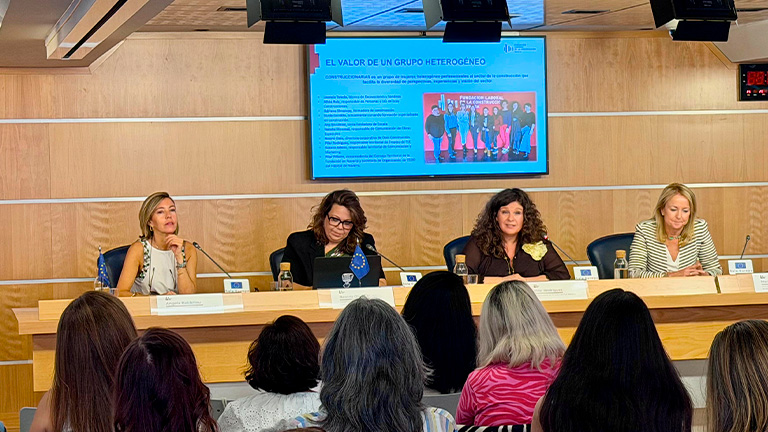
Along these lines, ‘Construccionarias’ was presented by Pilar Rodríguez, Head of Employment at the Fundación Laboral de la Construcción de Navarra, who recalled the labour shortage and lack of generational renewal that the sector suffers, advocating for “attracting women to construction”. “We have to transform the current situation, but this path must be walked together: women, companies, trade unions, administrations and society as a whole; they are all agents for change. Construction has to be women’s business and its future depends on all of us understanding this”. She concluded: “Visibility and female role models are what help act as levers for change”.
Likewise, ‘SOMOS ENERGÍA. For a just energy transition’ was presented by María Romera, Director of Institutional Relations at the Spanish Association of Women in Energy, AEMENER, who, from her perspective and experience in incorporating women into the energy work environment, advocated for the need to “make the construction sector known at an early age, since by age 7 there are already boys’ and girls’ careers. We mustn’t let these stereotypes exist, so we must provide vocational guidance from an early age” to future generations of professionals. In her opinion, “education and training is what makes us discover the importance of trades and makes us discover the charm of construction”. “We must know the sectors at early ages. This isn’t about genders, but about people and talent. Therefore, the role of teachers is decisive in deciding and instilling a professional career”, she reiterated.
Launch of the “Stories that Inspire” campaign
During the event, the launch of the “Stories that Inspire“ campaign was announced, available through the initiative’s YouTube channel. It consists of a series of testimonial videos featuring women workers in construction sector trades.
The visibility of female role models, vocational guidance and networking have been consolidated as decisive factors in favouring the incorporation of women in traditionally male-dominated sectors. Through the ‘Women Can Build’ initiative, more than 100 testimonials were disseminated, giving voice to women professionals in the sector in Europe. This new edition, the result of multilateral collaboration between organisations from EU Member States and Latin American countries, has highlighted first-person experiences of women from Chile and Argentina who have transformed their lives thanks to their work in construction, thus showing the scope of international cooperation for a just and inclusive transition.
Institutional closing
The session concluded with remarks by Begoña Suárez, Deputy Director General of the General Subdirectorate for Entrepreneurship, Equality in Business and Women’s Collective Bargaining, of the Women’s Institute, under the Ministry of Equality.
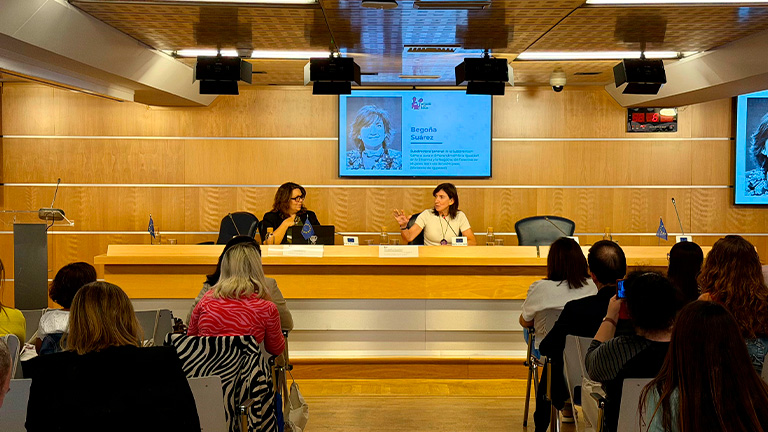
In her closing remarks, Begoña Suárez indicated that “we continue to be an androcentric society, subject to deeply rooted roles”. According to her explanation, the youngest, “in childhood, are still exposed to stereotypes in drawings, in films; society has the will to advance and at the same time is not aware of this reality. That is why the whole of society must commit to eradicating sexism, in order for all of us to have the same opportunities without bias”.
She also added that it is necessary to have “specific protocols to prevent harassment and reception protocols in construction companies, which help break down structural barriers, so that there are more women in the sector”, and insisted that “inequality is structural”, advocating for “incorporating the gender perspective in all strategic plans of Public Administrations and businesses: with this we can move forward”. She also mentioned the creation of networks “which is essential along with collaboration between all women’s or mixed associations in the construction sector”. “I believe we must work on a Great Union Network in the sector so that there is greater impact and we can advance in unison”, she concluded.